Madrid Renfe Guide: How to Get Around in Madrid on Public Transport
After living in Madrid full time for over a year now, one of the things I love most about life here is how easy it is to get around without a car. Madrid’s public transport system really has it all, and it’s a big part of why living both in the city and just outside of it feels so manageable.
This Madrid Renfe guide shows you how you can easily get around in Madrid using the Renfe (Spain’s long distance train system network, and in Madrid the Renfe has medium distance options for towns just outside of Madrid).
I live in Pinto, just south of Madrid, and I use the Renfe Cercanías train almost every single day to commute into the city. It’s fast, easy, and one of the reasons I’m comfortable living outside the center.
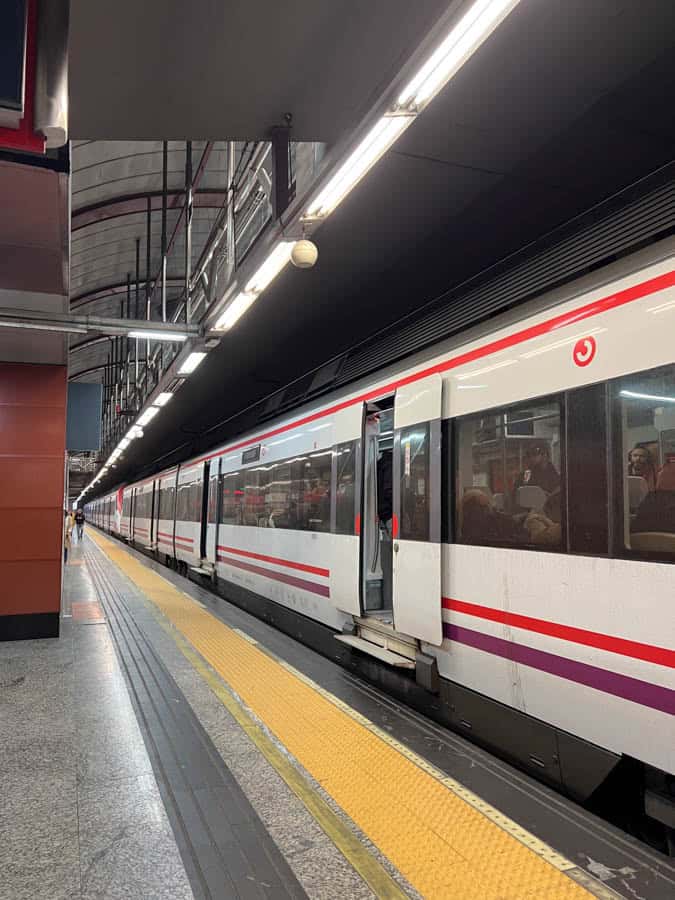
In about 20 minutes, I can be in Madrid without dealing with traffic, parking, or stress. Once you understand how Renfe works, it opens up so many options for where you can live and how you move around.
I actually believe that I can get to some destinations, like the major train station Atocha in Madrid, easier than if I lived elsewhere in Madrid! The Renfe makes it all easy, and this is your guide to using the Renfe in Madrid.
Public Transport in Madrid
Before getting into the details of Renfe and the different trains, it helps to understand how public transport in Madrid works as a whole.
Madrid’s public transport system is made up of three main parts that all work together: the Metro, Renfe Cercanías, and Renfe long-distance trains (including AVE). Each one serves a different purpose, and once you know when to use which, getting around becomes incredibly easy.
The Metro is what most people think of first. It’s the underground system that covers the city itself and nearby areas. It’s great for short distances, moving within central Madrid, and hopping between neighborhoods. If you live inside the city or are visiting tourist areas, you’ll probably use the metro a lot. Trains are frequent, stops are close together, and it’s usually the fastest way to get around within Madrid proper.
Then there’s Renfe Cercanías, which is the commuter train system. This is what people use to travel between Madrid and the surrounding suburbs, and it’s what I personally rely on almost every day.
Cercanías trains are faster than the metro, stop less often, and connect places like Pinto, Getafe, Alcobendas, Las Rozas, and many other towns directly to major stations in Madrid. If you live outside the city center, this is the backbone of your commute. For me, it’s what makes living outside Madrid easy and fast.
Finally, there are Renfe long-distance trains, including AVE high-speed trains. These are used for traveling between cities across Spain, not for daily commuting.
From Madrid, you can take an AVE train to places like Barcelona, Valencia, Seville, Málaga, or Zaragoza in a few hours or less. Madrid is one of the main transport hubs in Spain, which means living here also makes traveling around the country incredibly easy.
So basically, the metro handles city life, Cercanías connects the suburbs to Madrid, and AVE takes you across Spain.
Renfe & Renfe Cercanías: How I Use the Train in Madrid
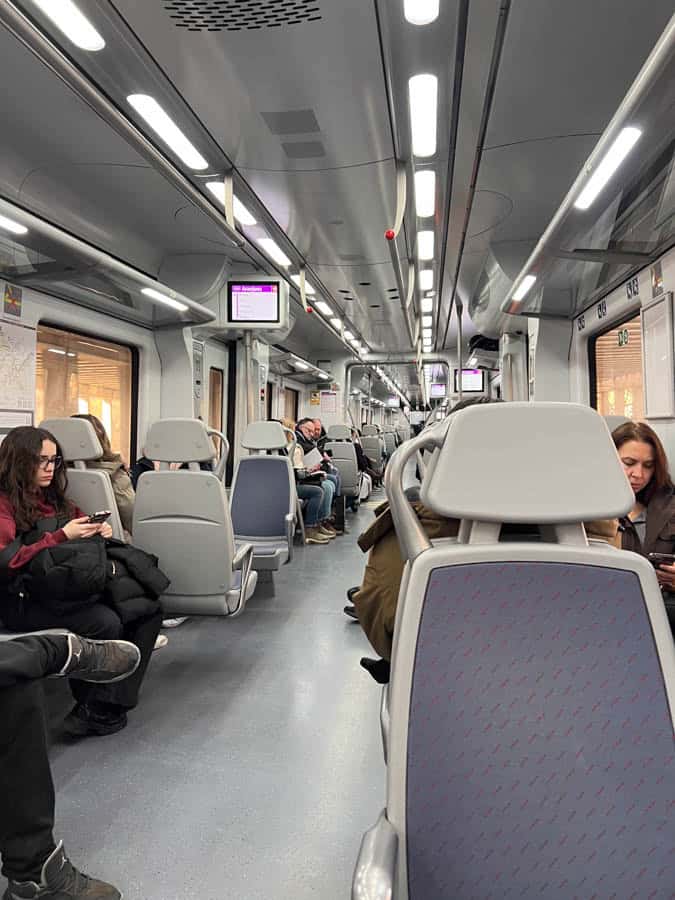
Compared to the metro, Cercanías trains are faster and stop less often. They’re designed to move people in and out of Madrid efficiently, especially during work hours. The trains are almost always clean, comfortable, and reliable, and once you get used to the schedule, commuting becomes very routine. For me, it’s about a 25-minute ride into Madrid, which is quicker than many commutes within the city itself.
Other major Renfe Cercanías stations you’ll want to know about include Chamartín, which serves the north of Madrid and connects many long-distance routes, Sol, which is the most central and connects directly to the metro, Nuevos Ministerios, which is a major interchange near business districts, and Méndez Álvaro, which links trains, metro, and long-distance buses. These stations make it easy to go across the city without ever needing a car.
Renfe Cercanías Lines & Buying Tickets
I’ll be honest… understanding the Renfe Cercanías lines was one of the most confusing parts of getting around Madrid for me at the beginning. There are a lot of lines, they go in every direction, and at first glance the maps can feel overwhelming.
The good news is that there are clear maps, and once you get used to them, things start to click. At every station you’ll find:
- A Renfe Cercanías map only
- A combined Metro + Cercanías map
Both are helpful depending on whether you’re staying within the city or coming in from the suburbs.
For checking train times, I don’t rely on Google Maps alone, the times are sometimes wrong, and I learned this the hard way.
What I personally use (and recommend) is a third-party app called Transporte Madrid.
It’s not an official city app, but it’s been extremely reliable for me.
- It shows real Cercanías and Metro times
- Usually accurate within about 5 minutes
- More reliable than Google Maps for Renfe
I check this app every single day before leaving the house.
How to Buy Renfe Cercanías Tickets
Buying tickets is another part of the transport process that confused me in the beginning, so if this feels overwhelming at first, you’re not alone.
At Renfe stations, you’ll see different ticket machines. Personally, I always use the Renfe Cercanías machines, not the long-distance Renfe ones. They’re easier and clearly labeled.
You have a few main ticket options:
- Single ticket (one-time trip)
- 10-trip pass (currently €18 in 2026)
- Monthly pass (currently €20 for 30 days, which is a great deal)
Here’s where things get confusing:
Renfe Cercanías works by zones (areas).
When you buy a ticket, you’re buying travel between specific zones, not unlimited access everywhere.
For example:
- Area 1 → Area 2
- Area 2 → Area 3
- Area 1 → Area 3
If you buy a ticket that covers Area 2 to Area 3, you cannot use it to travel from Area 1 to Area 2. The ticket only works for the zones you selected when you bought it.
The ticket machines will ask:
- Where you’re starting
- Where you’re going
Based on that, the system calculates the zone range your ticket covers. If you later try to use that ticket outside those zones, it won’t work at the gates.
This tripped me up early on because I assumed a 10-trip pass worked everywhere… it doesn’t. It works only within the zone range you paid for.
Renfe vs Metro: When to Use Each
This is one of the most common questions I get, and the answer is simple once you’ve actually lived here and used both. Renfe and the Metro serve different purposes, and knowing when to use each one makes getting around Madrid much easier.
I use Renfe Cercanías when I’m traveling longer distances, especially coming in from outside the city. Since I live in Pinto, Renfe is the obvious choice for me. It’s fast, makes fewer stops, and gets me into Madrid in about 20 minutes.
If you’re coming from the suburbs or traveling between major stations like Atocha, Chamartín, or Nuevos Ministerios, Renfe is almost always the better option.
The Metro, on the other hand, is best for getting around within Madrid itself. It’s great for short distances, neighborhood hopping, and anywhere central.
Trains come frequently, stations are everywhere, and during rush hour it’s usually faster than being stuck in traffic. If I’m already in the city and just need to move from one area to another, I almost always take the metro instead of Renfe.
Is Madrid Public Transport Worth It?
I use public transport almost every day, and it’s one of the reasons I love living here in Madrid. Granted, the Renfe isn’t perfect, trains aren’t always exactly on time, but it’s fast, affordable, and reliable enough that it makes suburban living easy.
Ubers do exist, but they’re not always the best option. Uber is usually the most expensive, while Boltor Cabify tend to be cheaper.
That said, Cabify cars can be harder to find (but cheaper as Cabify is from Madrid), so I usually default to Bolt if I’m not using public transport. Even then, during rush hour or in the city center, traffic can make rideshares slower and more annoying than just hopping on the metro or Renfe.
For me, public transport in Madrid is 100% worth it. It saves money, avoids traffic, and makes daily life easier. That’s why I recommend learning the system early… once you understand it, the public transport in Madrid becomes less about planning and more about confidence. And once you have that confidence, getting around Madrid feels simple!
FAQ: Getting Around Madrid on Public Transport
Is Renfe easy to use if you don’t speak Spanish?
Yes, it is. When I first moved here, I didn’t speak much Spanish, and I was still able to figure it out pretty quickly.
Can you live outside Madrid without a car?
Yes. I live in Pinto and commute into Madrid almost every day using Renfe Cercanías, and I don’t miss having a car at all. As long as you’re near a train station, public transport makes suburban living very doable.
Is Renfe or the Metro better for daily life in Madrid?
It depends on where you live. For me, Renfe is better for getting into the city quickly, and the metro is better once I’m already in Madrid. I use both regularly, and together they cover almost everything I need.
How reliable is the Renfe for commuting?
In my experience, it’s reliable enough to use daily. Trains aren’t always perfectly on time, but delays are usually minor, and I still find it faster and less stressful than driving or relying on rideshares.
Is public transport in Madrid worth it compared to Uber or Bolt?
Yes, especially if you’re commuting or traveling during busy hours. Ubers and Bolts can get expensive and slow with traffic, while Renfe and the metro are predictable and affordable. That’s why I think learning the metro and Renfe system is key to enjoying life here.